
How should I log safety pilot time?
Here’s a good question concerning logging of pilot time that I received from Don:
Can one log time as a safety pilot? If so, under what heading, eg, PIC, or a separate category “safety pilot“? Thanks.
First a quick review.
A “safety pilot” is a required flight crew member when another pilot is flying under simulated or actual instrument conditions in order to meet the IFR recency requirements of 14 CFR 61.57. FAR 61.57 requires that in order to file and fly on a IFR flight plan you have to be instrument current, which means that within the past 6 months you have logged 6 approaches, holding and intercepting and tracking procedures. If for some reason, those 6 months pass, the pilot has another six month grace period in which he can fly with a safety pilot under simulated instrument conditions in order to become fully instrument current again. In simulated instrument conditions the pilot wears a view limiting device that blocks the pilot’s view of the outside world so that he can only see the instrument panel (we call them foggles). This can present a problem for other airplanes as the flying pilot is unable to see where he is going! The FAA found a solution to this problem by creating the safety pilot. A safety pilot is simply that, someone who looks out for other airplanes (safety) while the other pilot is flying blind “under the hood”.
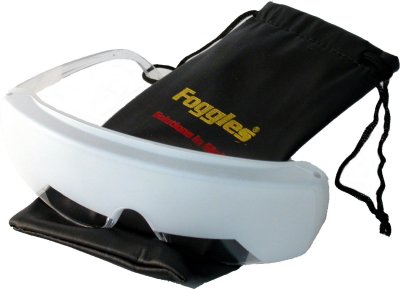
Instrument Training Glasses “Foggles”
So how do you log time flown as a safety pilot?
Because you are a required crew member when flying with a pilot under simulated instrument conditions the FAA allows you to log this time as SIC or second-in-command (61.51(g)). If you agree to be the “acting” PIC you and the other pilot could both record the time as PIC but only when the other pilot is under the hood and the other pilot is the “sole manipulator of the flight controls.” In order to be the “acting PIC” you will have to make sure that you meet the full PIC requirements for that flight and aircraft, which will include any necessary medical, category, class, type, recency and ratings requirements.
Don’t forget! If you use a safety pilot to gain instrument currency the FAA requires that you record the name of the safety pilot in your logbook.
As always…fly safe!

Mark Silva on Aug 08, 2010
Dear Sir,
With regard to Safety Pilot, can the safety pilot on an IFR flight plan log the flight as IFR as well?
Paul on Aug 08, 2010
Mark,
I’m not sure what you mean by logging the time as IFR? Do you keep track of all your time on an IFR flight plan? Most of the logbooks I’m familiar with have an instrument column that is then broken down to “simulated” or “actual”. The simulated column is usually reserved for the instrument flight time performed under the hood and the actual is for logging actual IMC time. The only time I log instrument time is when I was the PIC and “sole manipulator of the flight controls” (either simulated or actual). Also, as a flight instructor when I am training an instrument student who is not yet able to act as PIC on an IFR flight plan; if we go up in the soup, and I had to file an IFR flight plan, then even if I’m not flying, I’ll still log the time under PIC, dual given and actual IMC.
Professional pilots spend most of their pilot time on an IFR flight plan. Many pro pilots will still only log the time in actual IMC conditions. When you are at FL410 and it’s clear skies, there is really no point in logging “IFR”?
Again, as it has been pointed out before, you can log just about anything you want, it just might make it complicated when it comes time to sorting out how your flight experience can be applied to currency, recency or the required time towards a certificate or rating (which is all logbooks are legally really for)
Paul
Jenn on Nov 19, 2010
Tomorrow I am going to be acting as a safety pilot in a high performance aircraft. I do not have an HP endorsement. Can I still log this as PIC time? The regulation states that I only need to be rated for the category and class of aircraft, which I am, I just don’t have the high performance endorsement.
Paul Tocknell on Nov 20, 2010
Jenn,
I think you might be confusing some things. While you do meet the requirements of a safety pilot (§91.109), you don’t meet the requirements to be the “acting” PIC according to §61.31(f). §61.31(f) states that in order to act as PIC of a high performance airplane you must have a high performance endorsement. Until you meet those requirements, you can not “act” as PIC of a high performance aircraft. You can log the time as SIC though as you are a required crewmember while the other pilot is under simulated instrument conditions.
Have a safe flight!
Paul
Alex on Jul 03, 2012
Question here….I’m a Commercial Multi-engine pilot with a high-performance endorsement who hasn’t logged multi-time in over a year…I went up recently in a Cessna 310 acting as a safety pilot. I was sitting right-seat…technically I can’t log PIC time while he was under the hood because I’m not current to “carry passengers” in a multi-engine aircraft (3 landings in previous 90 days), am I right? I can however log the two hours of multi-time, but it must be listed under “SIC” correct?
Steve CFI (w/ I and ME) ATP B727, B767, A310 on Dec 04, 2012
Look at:
61.55 a:
“…or in operations requiring a second-in-command pilot flight crewmember.”
61.55 a (2):
“…being flown if the flight is under IFR”*
A pilot flying under the hood requires a “safety pilot”. It is NOT an operation requiring a “Second In Command”.
The aircraft is not being flown under IFR unless you are on an IFR clearance.
Bottom line is you can log whatever you want to log. There are MANY log books that have two pilots logging PIC for the same flught when there are two pilots “sharing” the expenses of the flight while only one person is the PIC.
Side note: Acting PIC is for the SIC when the PIC is away from the controls.
The question is what is it you want to do with your log book.
Steve CFI (w/ I and ME) ATP B727, B767, A310 on Dec 28, 2012
OK, I was wrong…..
After posting what I believed to be correct I contacted the Altanta Reg. FAA Office Legal Dept. I just got the anwer this morning (12/28/12).
Here is THEIR “verbal responce” (read” you can/should call them to get the “verbal” answer as there was no “formal” request of a “judgement/interprtetation” of my question):
If a pilot were to fly under the hood without a safety pilot the pilot would be violated (for dangerous/reckless). Thererfore a safey pilot is a required pilot on the flight and CAN log second in command time. But ONLY the time acting as “safety pilot” (when the other guy is under the hood ONLY).
I think if you have a bunch of it in your log book and you want to use it for an pilot job it would behoove you to submit a formal request of a ruling to bring with you to an interview.
Frank M on Jan 09, 2013
So if I am a single engine-land PPL serving as a safety pilot in a single engine land A/C how do you log the entire line?
EX: if it is a 1 hr flight and I only served as the acting PIC for 30 min:
single engine-land night actual inst hood sim XC solo dual PIC total
1.0 .5 1.0
Would that be correct?
Douglas on Oct 19, 2014
I understand that if I log PIC time as safety pilot, it won’t count towards a rating (such as the 250 he requirement for the commercial rating). However, will it count for meeting the hourly requirements for a pilot job?
Badger Fishinaki on Oct 05, 2016
Can a SEL PPL act as a safety pilot for another SEL PPL, flying in VFR conditions under the hood? If so, I would assume because both crew members are required for the flight, then both could log PIC time (one as safety pilot, and the other as sole manipulator of the controls). My main question tho is this….Since it is in VFR conditions, and the IFR flying is simulated under the hood, then I would think that the safety pilot or the guy under the hood, does NOT need to be IFR rated. Can you confirm please?