
Why are the visibility requirements so low on a LNAV only approach?
I received an outstanding question this afternoon concerning instrument approach visibility minimums from Michael. His question went something like this:
I’m looking at the RNAV (GPS) Z Runway 31 at McNary Field in Salem, Oregon (SLE) and I can’t make sense of the minimum visibility requirements of the approach. Why is it that the visibility requirements for the LNAV only are so low? On this particular approach the required visibility for the LNAV only is 2400 RVR or about a 1/2 mile. That doesn’t make any sense! I wouldn’t be able to descend from a MDA of 940 with only 1/2 mile of visibility! Can you help shed some light on it?
Like I said mentioned before Michael, great question. Let’s take a look at the RNAV Z RWY 31 approach into SLE. For those who are interested, you can view a copy of the approach plate from EchoPlate:
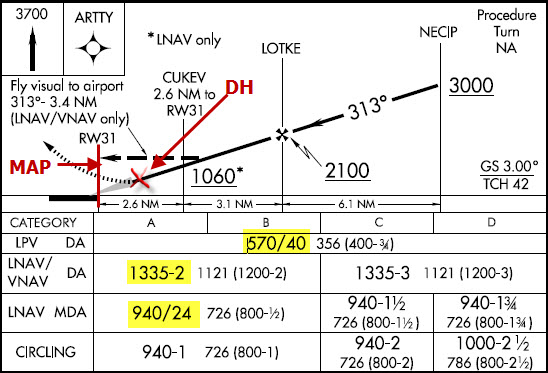
Maybe at some point we’ll go over the terms and definitions of this approach plate a little more throughly, but for now, I’m going to try and just answer your question about the confusing visibility requirements.
Why are the visibility requirements so low for the MDA on the LNAV only approach?
The reason is the differences in the physical location of the Missed Approach Point (MAP) between the different approach types authorized for this approach. Take a look at the MAP for the LNAV only approach and then compare it to the MAP for the LNAV/VNAV approach. I have highlighted in red the locations of these two different MAPs in the illustration above. For the LNAV only, the MAP is basically the start of the runway. If you reach this MAP without having 2400 RVR AND you don’t meet the requirements of 14 CFR 91.175 then you must begin the missed approach procedure. For the LPV approach and the LNAV/VNAV approach, the MAP corresponds with the DA which is most likely going to be physically further from the runway thus the higher visibility requirements.
Now you bring up an interesting point about the practicality of this approach. Let’s say you are at a MDA of 940 and suddenly you have the airport environment and the required min. visibility, so you should “chop and drop” in right? Well, let’s read 91.175 again. 14 CFR 91.175 says that in order to operate below MDA you have to be:
In a position from which a descent to a landing on the intended runway can be made at a normal rate of descent using normal maneuvers
So it may very well be that you have the required visibility before the MAP and you still have to execute a missed approach simply because you are not in a condition that you’ll be able to make it to the runway surface using safe and normal maneuvers.
I hope this clarifies things for you Michael. If you have any other questions, feel free to comment on the this post and I’ll do my best to find an answer for you.
If anyone else has questions about the terms used in this explanation, feel free to ask me a question about which term you are confused about.
Thanks again for your question and ….
Fly Safe!
Michael on Aug 08, 2008
Paul, thank your for your answer but even after posing this question I was still preoccupied with the ‘practicality’ part, namely it was tough for me to imagine FAA would design conditions in which safe landing would not be possible. So after asking this question I wanted to make some calculations about descent rates, speeds, angles, touch down points to settle the question whether landing was in fact possible at least in some GA aircraft. I think it is possible. Assuming 1/2 mile visibility and approach lights, I found the likely place (still at MDA) where pilot could begin legal descent and then assuming the aircraft was category A/B and that the last 2000 ft of the runway could suffice for landing I calculated the required approach angle to be about 6 deg (double of normal 3 deg.) which translates to roughly 700-800 fpm. I think FAA would be OK with this, Part 91 operations if I am not mistaken are not required to touch down in the first 2000 ft of the runway and 700 fpm is not necessarily abnormal since VFR folks do it all the time (even my FAA examiner did it during my PPL checkride). So now I believe it is not only location of MAP but in fact even in minimum weather conditions a skillful pilot could land safely.
Tim Kuo on Feb 11, 2009
It’s great you spot that Michael. I was wondering about the same thing myself. I also have another question about this particular chart or the GPS approach in general. Why is the LNAV/VNAV DA much higher than LNAV itself. I thought VNAV provides a vertical guidence and shouldn’t it let us to go lower?? I looked into VNAV approach and I found something from FAASafety website stating the following:
“The ROC on final varies with distance from runway (minimum 250 feet) because the obstacle clearance is evaluated by a sloping obstacle surface rather than a set
ROC value. While this occasionally results in minima higher than the LNAV minima, the added safety benefit of a stabilized descent outweighs the difference
in minimums.”
With that statement, it is still not clear for me. Could you explain that in a little more detail. I appriciated.
Mikel Gardner on Nov 28, 2009
I read your response for the vis. requirements on theOn theRNAV (GPS) Z Runway 31 at McNary Field in Salem, Oregon (SLE). I’m still a little confused. Please explain why the MDA and vis. requirements for the RNAV (GPS) RWY 4R at LFT (Layayette Regional, LA) LNAV/VNAV DA is 537-1 3/4 verses LNAV MDA is 480-1.
The way I see it the MAP for the LNAV is 1.2 miles from the RWY end and you only need 1 mile visibility. For the LNAV/VNAV you are at the DA at RWY end and you need 1 3/4 visiblity. I don’t get it.
glen on Feb 24, 2010
Michael: No, it is not legal. No way no how. The references all apply to the landing zone of the runway and that is defined. It is definitely not the landing zone for the opposite runway direction.
Check some other approaches and calculate the required visibility to see the runway at the MDA/DH. In most cases the required vis is less than the distance the airplane would be from the runway when it reaches the min alt on a normal glideslope. No matter what the reported visibility, the only vis that counts is the one you actually have and if you can land without heroics, go ahead. If you have to duck and dart, in low vis, you will have a very short flying career.
John D. Collins on Jan 24, 2011
Tim,
The reason for the higher visibility requirement in this case, has to do with the distance from the threshold of the LNAV/VNAV DA. The LNAV MDA is lower because of the stepdown fix. The LPV DA is lower, because the protected area evaluated for obstructions is smaller than for either the LNAV or LNAV/VNAV. Since the LNAV/VNAV can’t step down over the controlling obstacle, the DA is moved far enough back and therefore up to allow the obstacle to be in the visual segment so the pilot can see and avoid it. Even so, the location of the LNAV/VNAV DA is 3.4 NM or just over 3.9 miles from the runway threshold. This would require a visibility of nearly 4 miles in order to meet 91.175 requirements, which is better than VFR conditions. Since the minimum visibility is 2 NM, one could ask the question, how could you ever complete the approach if the visibility was at minimums, since 91.175 requires you to see the runway, etc. … in order to descend from the DA. The answer is in the note that applies to the LNAV/VNAV minimums that says: “fly visual 3.4 NM to airport” and a dashed line is shown with an arrow pointing towards the airport. This authorizes the pilot to continue the approach to the runway and descend from the DA as long as the required flight visibility of 2 miles is available. Since this is a visual maneuver, the pilot is responsible for obstacle avoidance and must remain clear of clouds. Altitude is at the pilots discretion. However, once the pilot decides to leave the DA, the missed approach procedure protection from obstacles is no longer available, so the pilot should be fairly certain they will be able to complete the approach visually.
John D. Collins on Feb 03, 2011
Glen,
First of all, the requirement to land on the first part of the runway doesn’t apply to part 91 operations. See 91.175 (c)(1) “The aircraft is continuously in a position from which a descent to a landing on the intended runway can be made at a normal rate of descent using normal maneuvers, and for operations conducted under part 121 or part 135 unless that descent rate will allow touchdown to occur within the touchdown zone of the runway of intended landing”.
A normal descent angle for my Bonanza is different than normal for a business jet. In normal pattern work, I use a descent angle of approximately 6 degrees and 8 degrees would represent a power off approach. The landing roll for my Bonanza is well under a 1000 feet, so touching down on the last 2000 feet of the runway can safely and easily be accomplished with a 100% buffer above my personal requirement. If I choose to land on the last few thousand feet of the runway, I am not in violation of the FAR 91.175 as I normally use much less than 2000 feet in my regular flying, and in fact I regularly decide where to touch down so as to keep my time on the runway to a minimum.
Each pilot should know there own limitations and the capabilities of their aircraft and operate within them along with the prevailing conditions, What might be safe for one pilot may not be for another. The regulations allow for those differences.